
A transition connects two activities and indicates the order of the activities. There are two types of transitions: normal transition and exception transition.
There are two types of normal transitions: one is the conditioned routing transition and the other is the default routing transition. The conditioned routing transition is a transition based on described condition expressions. The default routing transition is the transition that is selected when all the conditioned routings are evaluated to be FALSE.
There are two types of exception transitions: one is the conditioned exception transition and the other is the default exception transition. The conditioned exception transition is a transition based on a described transition for the specified exception. The default routing transition is the transition that is selected when all the conditioned exception transitions are unable to receive any exception.
Routing defines the order in which activities are performed. Routing determines which transition is selected at runtime of Workflow.
Described below are the basic routings of Workflow.
The following routings are possible in addition to the transition start point and end point.
Performs the connected activities in the order specified by the transition.
Fig.: Sequential Routing
Performs multiple activities in parallel. Parallel routing is started by an AND branch, and ended by an AND combine or OR combine.
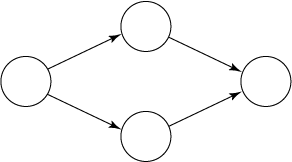
Fig.: Parallel Routing
| Item | Description |
|---|---|
| AND Branch | Starts a parallel routing. The previous activity contains the condition expressions to be evaluated. The AND branch evaluates all the condition expressions, and selects all the paths that meet the conditions (proceeds to perform the next activity). Every transition that is output from an activity other than OR Branch is performed as an AND branch. An end, termination, or exception activity cannot be specified as previous activity. |
| OR Branch | Out of the outgoing multiple chains of routes, only one chain is performed. The previous activity contains the condition expressions to be evaluated and the order of evaluation. An OR branch is a point from which the flow bifurcates into multiple sequential routes. |
| AND Combine | This allows the flow to transit to the next activity when one or more entry have been made, and no active activity is left to be reached. Every transition that is input to an activity other than OR Combine is performed as an AND combine. A start activity cannot be specified as next activity. |
| OR Combine | This allows the flow to transfer to the next activity when one entry has been made. When parallel routes are combined with the OR Combine, the flow will transfer to the next when one of the routes reaches the OR combine. Only the first route that has reached the OR Combine can transit to the next activity. In order to realize an OR Combine, set the OR combine activity on the combine area of routings. If you want to cancel one of the routing activities with an input from another route, set a branch and an OR combine within a block, and then set the cancel operation as the subsequent activity following the OR combine. In addition, on the OR combine in a loop, the flow does not transfer to the next activity of the OR combine by the second or later input. When an OR combine is needed for a loop, the transition status shall be reset by setting an OR Combine in the block. |
| Loop | When a transition is directed to somewhere between the starting point and one of the previous activities, that route is called a loop. When using a loop, the end condition for the flow to get out of the loop needs to be described in any of the transitions constituting the loop. |